
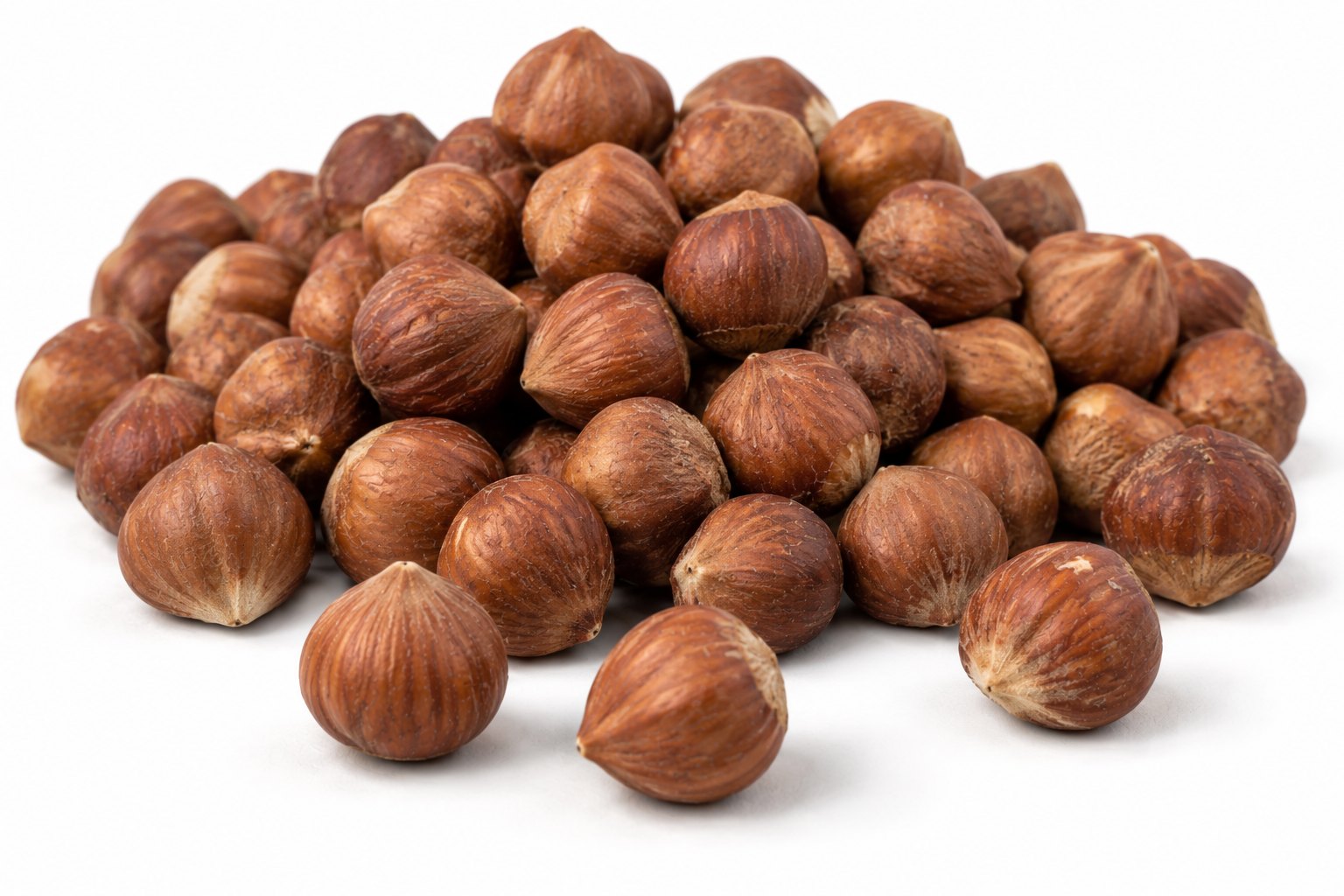
Calibre is the first thing a hazelnut buyer specifies and the last thing anyone wants to argue about after the container lands. This guide explains how sizing works, what the trade grades actually mean, and which calibre suits which production line.
Calibre is the diameter of the kernel, measured in millimetres across its widest point. Lots are screened over round-hole sieves, so a “13–15 mm” lot is one that passed over a 13 mm screen and through a 15 mm screen. Because kernels are not perfect spheres, every calibre band carries a tolerance for kernels that fall outside it — under the Association of Food Industries (AFI) specifications for shelled hazelnuts, that size variance tolerance is 5% by weight for both Extra Class and Class I.
Two lots with the same average weight can behave very differently on a line. A tight band gives you predictable roasting, even coating and consistent counts per pack; a wide band is cheaper but costs you in rework.
Most European and North American contracts are written against the AFI size designations. The four bands you will meet most often:
| Trade name | Calibre | Approx. kernels per ounce |
|---|---|---|
| Regular FAQ | 9–15 mm | 35–40 |
| Standard No. 2 | 11–13 mm | 35–38 |
| Standard No. 1 | 13–15 mm | 23–27 |
| Special Standard | 14–16 mm | 20–24 |
The minimum size for Extra Class and Class I kernels is 9 mm. The Piccolo type is the exception, running 6–9 mm. “FAQ” stands for fair average quality: a wide, unselected band that reflects the season’s natural spread rather than a screened selection.
Calibre without a defect schedule is only half a specification. AFI sets these tolerances by weight:
| Defect | Extra Class | Class I |
|---|---|---|
| Shrivelled or stained kernels | 2% | 4% |
| Rancid, mouldy or insect-damaged | 1% | see note* |
| Mechanically deteriorated / pieces | 3% | 7% |
| Unshelled, fragments, dust | 0.2% | 0.2% |
| Foreign matter | 0.05% | 0.05% |
| Size variance | 5% | 5% |
*Class I: not more than 2% overall, of which not more than 1% mouldy, rancid or insect-damaged.
The jump from Extra to Class I on mechanical damage — 3% to 7% — is the line item that most often explains a price gap between two quotes that look identical on calibre. Read both columns before comparing prices.
AFI specifies 3–6% moisture, with 6% the ceiling. Moisture interacts directly with calibre economics: a lot delivered at the top of the range carries water you are paying for by weight, and it shortens shelf life. Ask for the moisture figure on the certificate of analysis, not just a pass/fail. Our approach to lot-level testing is set out on the quality assurance page.
Five lines, and most specification disputes disappear before they start.
Everything we ship begins in our own orchards in Giresun, so the calibre spread you receive reflects one origin and one season rather than a blend of unknown lots. Calibre, roast profile, texture and packaging are set to your specification before production starts. If you tell us the product, the band, the destination and the volume, we quote against that — start on the request a quote page, or read how the crop is grown on our orchards.
Talk to us
Tell us the product, calibre, packaging, volume and destination port, and we quote against that specification.

Let's grow together
Product, calibre, volume and destination — send those and we come back with a quotation and a sample offer.
info@edorahazelnuts.com · +90 544 425 6091 · Giresun, Türkiye
Necessary cookies keep the site working. Analytics and marketing cookies are only set if you accept.