
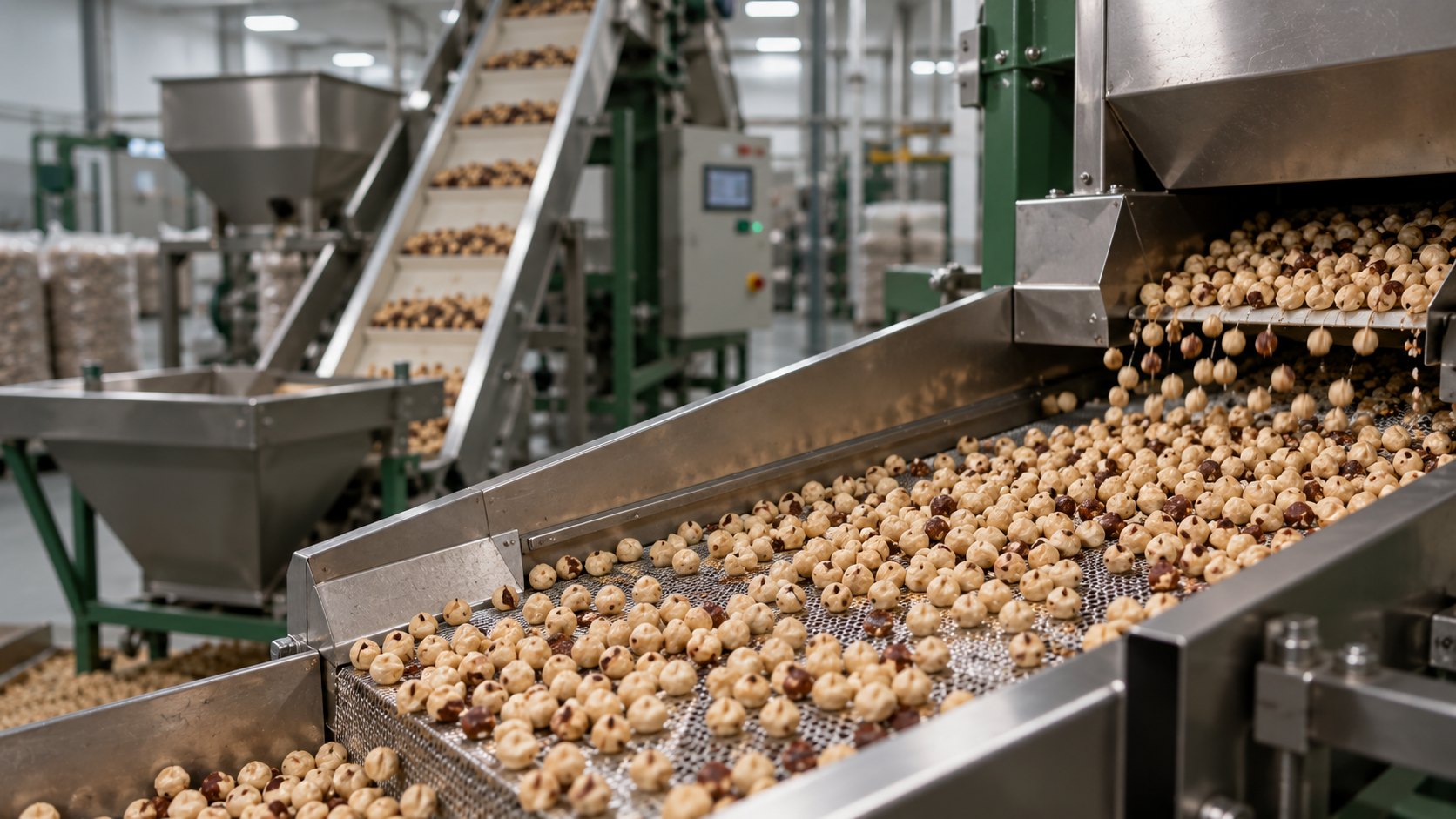
Hazelnuts do not fail in the warehouse. They fail in the four weeks between a Turkish loading bay and a European or North American receiving dock — and almost always because of packaging, moisture or a container decision nobody wrote down. This is the part of the specification buyers skip.
A hazelnut kernel arrives at packing with a defined moisture, a defined fat content and an intact or removed pellicle. Everything that happens to it after that is a race between oxidation and consumption. Packaging decides how fast that race runs.
Three variables matter, in this order: exposed surface area, oxygen contact and temperature stability. A whole raw kernel in a 25 kg kraft bag is a slow, forgiving product. The same kernel diced, roasted and left in an unlined bag is a fast one. Choose the pack from the form, not from the price list.
The industrial default. Multiwall kraft paper with a food-grade liner, or woven PP. They palletise cleanly, they are easy to sample on arrival, and they suit a buyer who will open and consume a pallet within a predictable window. The 25 kg unit is easier on manual handling and on partial-lot traceability; the 50 kg unit lowers packaging cost per tonne. Both are offered across our kernel range.
Air is removed, so oxidation slows sharply. This is the right choice for blanched kernels, roasted kernels, pieces and any product whose fat is already exposed, and for any lot that will sit in storage rather than move straight into production. It also protects against the sweat-and-condense cycle inside a container crossing a temperature gradient. It costs more per tonne; it is usually cheaper than a rancidity claim.
Bulk FIBC for high-volume buyers feeding a continuous line. The economics are excellent — minimal packaging per tonne, fast discharge — but the whole bag becomes one traceability unit and one exposure event once it is opened. Big bags suit processors with sealed transfer systems and steady throughput, not buyers drawing down slowly.
A different discipline entirely, driven by barcode, label law and shelf presentation in the destination market. If this is your channel, raise it at quotation stage rather than after production, because the labelling requirements are the destination’s, not the origin’s.
Hazelnuts are dense relative to their volume, so a loaded container usually reaches its weight limit before it runs out of space. The practical consequence: a 20 ft container is the normal unit for kernel shipments, and volume-based container comparisons will mislead you. Confirm the achievable net weight for your specific pack format and pallet plan before you build a landed-cost model on it.
Three loading points are worth insisting on:
A hazelnut shipment into the EU or North America normally moves with a commercial invoice, packing list, bill of lading, certificate of origin, a health or phytosanitary certificate depending on destination, and a certificate of analysis covering aflatoxin and moisture. Getting the aflatoxin category on the certificate to match the category you contracted under is the detail that most often stalls a consignment at the border — the aflatoxin and EU limits guide covers how those categories work. The full document set we ship against is listed on export & logistics.
Across the kernel range we pack in 25 kg and 50 kg units, vacuum, or big bag, and specify a 12-month shelf life in original packaging with cool, dry storage — vacuum packing is what we recommend when the product will be held rather than used. Because the crop comes from our own orchards in Giresun, the lot code on the bag traces back to a harvest block rather than to an aggregator’s blend. How that traceability is built is on quality assurance, and the crop behind it on our orchards.
If you are choosing between formats, the form you are buying usually decides it — our guide to raw, roasted, blanched and milled forms works through that, and the calibre and grading guide covers the clause that sits next to packaging in every contract.
Tell us the product, the pack format, the destination port and the volume, and we will quote against it — request a quote, or browse all products.
Moisture range cited from Association of Food Industries specifications for shelled hazelnuts. Container weights and documentary requirements vary by carrier, route and destination — confirm current requirements for your market before contracting.
Talk to us
Tell us the product, calibre, packaging, volume and destination port, and we quote against that specification.
Let's grow together
Product, calibre, volume and destination — send those and we come back with a quotation and a sample offer.
info@edorahazelnuts.com · +90 544 425 6091 · Giresun, Türkiye
Necessary cookies keep the site working. Analytics and marketing cookies are only set if you accept.