
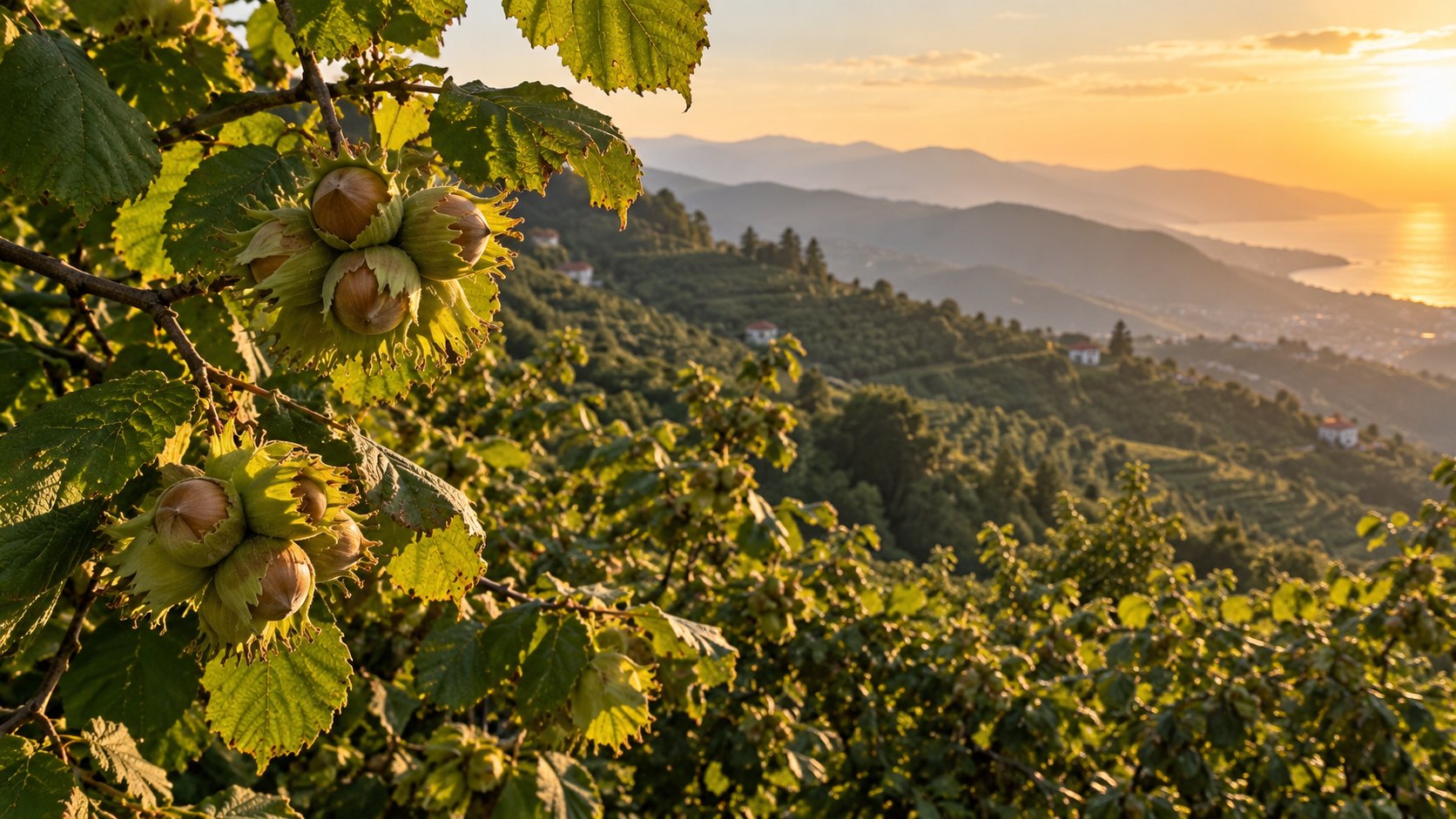
Hazelnut buying is a calendar business. Knowing when the crop is picked, when it is cracked and when it can realistically ship changes what you pay and what you get. Here is how the Turkish season works from a buyer’s point of view.
Türkiye is the world’s largest hazelnut producer. The International Nut and Dried Fruit Council put the country at 66% of global production, on an average crop of about 715,000 tonnes in-shell across the 2012/13–2021/22 period. Production concentrates along the Black Sea coast: the eastern region — Ordu, Giresun, Samsun and Trabzon — accounts for 73% of the bearing area, with the western region from Sinop to İstanbul making up the rest.
That concentration is why a frost in one Black Sea valley moves prices on three continents, and why the Turkish calendar is effectively the global calendar.
“New crop” is used loosely and costs money when it is. Pin it down:
Because Turkish hazelnuts hold for up to two years in ordinary warehousing, carry-over stock is a legitimate option — and for paste, flour and praline applications it is often the more sensible buy. What matters is the storage history and the moisture, not the year on the label. Ask for the moisture figure and the storage conditions rather than paying a premium for the word “new”.
Where old crop genuinely does lose ground is in whole-nut applications where a fresh pellicle and maximum visual uniformity are the product — chocolate enrobing, premium retail packs.
Tombul is the variety that carries Turkish hazelnut quality in the trade, and Giresun is the province most associated with it. A buyer should treat variety and origin as two separate lines in a specification: naming the province tells you about the growing conditions, naming the variety tells you about kernel shape, pellicle behaviour on roasting and blanching yield. Specify both, or accept that you are buying on price.
Everything we ship comes from our own orchards in Giresun — one origin, one season, traceable to the block it was harvested from. How that works in practice is on our orchards, and what the origin and the variety each contribute is set out in why Giresun.
Whatever the season, the specification does the work: calibre band, class, moisture ceiling, aflatoxin category and packaging. Our guides to calibre and grading and to aflatoxin and EU limits cover the two clauses that cause most disputes.
Tell us the product, the volume, the destination port and the crop year you want, and we will quote against it — request a quote.
Production shares and harvest timings cited from the International Nut and Dried Fruit Council industry profile of Turkish hazelnuts (April 2022). Crop sizes vary year to year.
Talk to us
Tell us the product, calibre, packaging, volume and destination port, and we quote against that specification.
Let's grow together
Product, calibre, volume and destination — send those and we come back with a quotation and a sample offer.
info@edorahazelnuts.com · +90 544 425 6091 · Giresun, Türkiye
Necessary cookies keep the site working. Analytics and marketing cookies are only set if you accept.